
Freeze drying cooked food is one of the most interesting and commercially ambitious applications in modern food processing. It allows prepared meals to be converted into lightweight, shelf-stable products that can be stored for long periods and rehydrated when needed. This makes the category highly relevant for convenience foods, travel meals, institutional supply, premium emergency food packs, adventure foods, defence-style applications, and export-focused ready-to-eat formats.
In India, interest in freeze dried cooked food is increasing because many startups are exploring ready-to-eat or instant meal concepts based on local eating habits. Products such as pulao, seasoned rice, mixed vegetables, dal-based meals, curry combinations, and similar cooked food formats are being evaluated for commercial potential.
However, this segment is not as simple as freeze drying fruits or herbs. Cooked food is more complex because it contains multiple ingredients, varying moisture levels, oils, spices, starches, and structural changes caused by cooking itself. That is exactly why this category needs deeper technical understanding before investment.
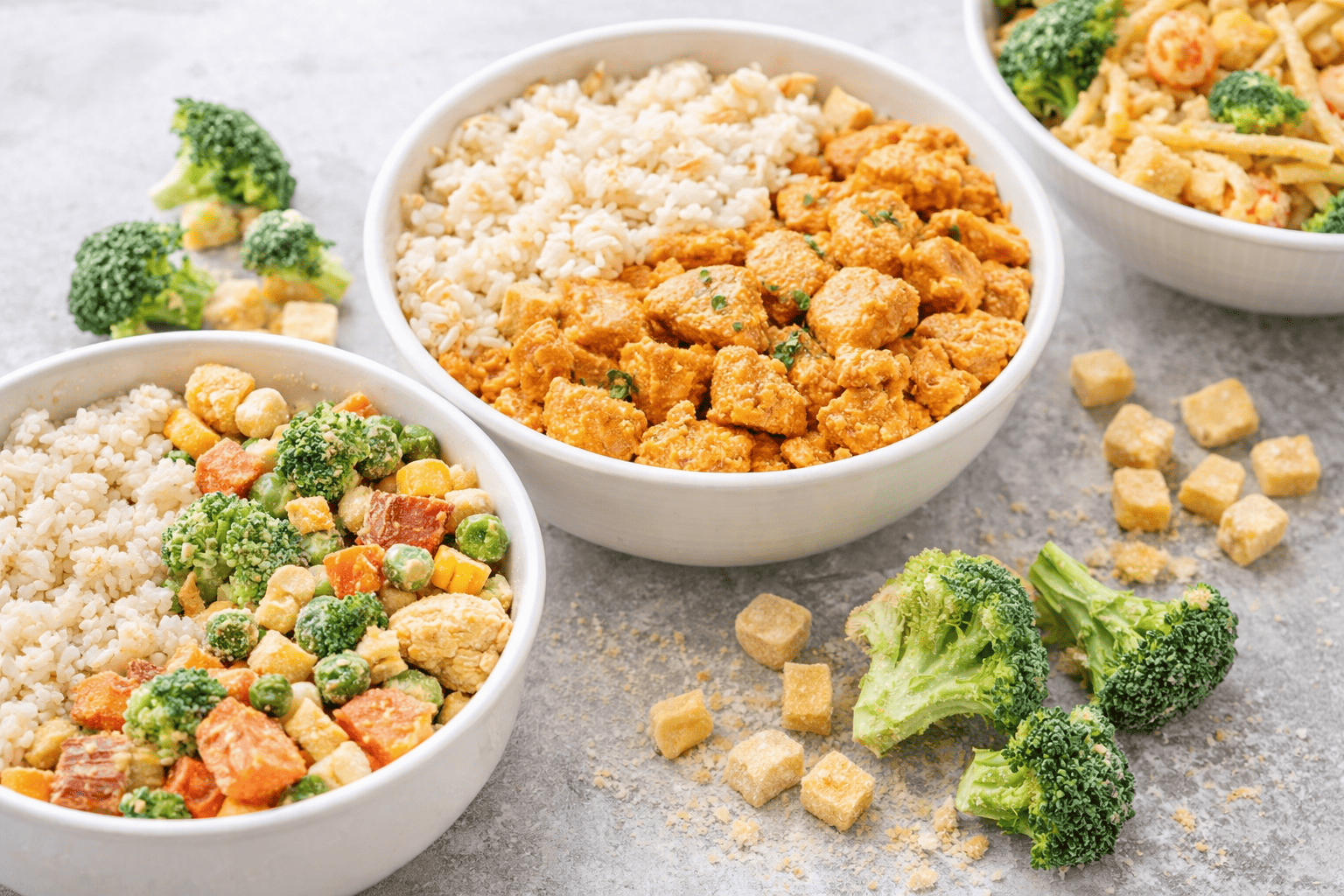
Freeze dried cooked meals can offer long shelf life and convenience, but process control and product formulation are critical.
What Is Freeze Drying of Cooked Food?
Freeze drying of cooked food is the process of taking a prepared meal or cooked food component, freezing it properly, and then removing moisture under vacuum through sublimation. Instead of using high heat to dry the product, the water present in the frozen food is removed gently under controlled conditions.
The goal is not only to reduce moisture, but also to preserve enough structure, flavor, and rehydration behavior so that the product can later be restored close to its usable form after adding water.
Important reality: freeze drying cooked food is more demanding than freeze drying simple raw slices of fruit or leaves of herbs. The final success depends heavily on food formulation, cooking method, oil content, particle size, and rehydration performance.
Why This Segment Is Attracting Attention
The freeze dried cooked food segment attracts interest because it combines convenience with shelf life extension. For the right product and target market, it can become a premium category with strong differentiation. This is especially important in markets where customers value portability, fast preparation, reduced storage burden, and premium ready-meal formats.
- Useful for ready-to-eat and instant meal concepts
- Can reduce storage and transport burden due to lower moisture
- Suitable for premium travel, outdoor, and convenience meal formats
- Attractive for long shelf life applications when packed correctly
- Can support product innovation in modern food processing
- Useful for specialized B2B and export-oriented packaged meal products
What Type of Cooked Food Can Be Considered?
Many people assume that any cooked meal can be freeze dried easily. In practice, different food types behave very differently. Meals with balanced structure, controlled oil content, manageable particle size, and good rehydration characteristics tend to be better candidates than heavily oily, sticky, or highly unstable foods.
Rice-Based Meals
Pulao, seasoned rice, vegetable rice, and similar products can be explored when grain separation and rehydration behavior are managed well.
Curry Components
Selected curry-based products may be possible, but oil level, spice load, and sauce behavior become very important.
Vegetable Mixes
Cooked vegetable combinations can work well when the product is not excessively oily or overcooked before drying.
Meal Components
In many cases, individual meal components may perform better than attempting a highly complex full mixed dish from the beginning.
Why Cooked Food Is More Complex Than Fruits or Herbs
Fruits and herbs usually involve relatively simple product structures. Cooked foods are different because they contain multiple ingredients, each with its own moisture level, density, texture, and thermal response. Rice, vegetables, proteins, gravies, starches, and spices do not all dry or rehydrate in the same way.
Cooking itself already changes the structure of food. Starch gelatinization, oil absorption, softening, emulsification, and ingredient interaction all affect how the product behaves during freezing, vacuum drying, and later rehydration.
That means: a meal that tastes excellent when freshly cooked may still perform poorly in freeze drying if it collapses, hardens, separates badly, or fails to rehydrate properly.
Step-by-Step Freeze Drying Process for Cooked Food
A proper process approach is essential in this category. Below is a practical workflow that helps readers understand how freeze drying cooked food is typically approached at a development level:
1. Product Selection and Formulation
The first step is not machine loading, but selecting a food that has real potential for drying and rehydration. Meals with very high oil content or unstable structure may need reformulation before freeze drying can work properly.
2. Controlled Cooking
The meal should be cooked in a controlled way. Overcooking can damage texture and make rehydration worse later. In many products, slight process adjustments may be needed compared to standard fresh-consumption cooking.
3. Portioning and Tray Loading
Food should be spread in controlled thickness for more uniform freezing and drying. Large clumps, uneven depth, or highly compact mass can affect performance badly.
4. Pre-Freezing
The cooked food must be frozen properly before the drying stage. Good freezing is essential because the structure formed at this stage influences sublimation and final product behavior.
5. Primary Drying Under Vacuum
Moisture is removed under vacuum through sublimation. Stable vacuum, proper condenser temperature, and controlled heat input are critical. Too much energy or poor vacuum can damage product quality.
6. Secondary Drying
Residual moisture must be reduced to improve storage stability. This stage is extremely important in cooked foods because hidden moisture pockets can create quality or shelf stability issues later.
7. Rehydration Testing
This is one of the most important stages. The product must be tested for water uptake, texture recovery, taste, appearance, and practical usability after rehydration.
8. Packaging
Once dried, the product must be packed immediately in suitable moisture-barrier packaging. Any moisture pickup from ambient air can reduce crispness, shelf stability, and rehydration quality.
Key Technical Factors That Matter Most
In cooked food freeze drying, process details matter more than many beginners expect. A product may look acceptable initially, but still fail commercially if the rehydration is poor or the texture becomes unpleasant.
| Process Factor | Why It Matters |
|---|---|
| Oil and fat content | Higher oil levels can complicate drying, storage behavior, and sensory performance |
| Particle size and meal structure | Large or uneven components can create drying inconsistency |
| Pre-freezing quality | Affects internal structure and sublimation efficiency |
| Vacuum stability | Poor vacuum performance can delay drying and reduce product consistency |
| Controlled heat input | Too much energy can damage delicate cooked structure |
| Rehydration behavior | A commercially successful product must recover acceptably after water addition |
| Packaging quality | Moisture barrier performance is critical for shelf life and texture retention |
Why Rehydration Performance Is So Important
In cooked food applications, rehydration is often the true test of product quality. A freeze dried cooked meal is not judged only by how dry it looks, but by how well it returns after water is added. This includes texture, softness, grain separation, taste delivery, sauce behavior, and overall eating experience.
For example, a rice-based meal may dry successfully but still perform poorly if the grains become hard, overly sticky, or fail to recover properly during rehydration. Similarly, vegetable or curry components may lose structure or mouthfeel if the formulation is not suitable.
Commercial lesson: a freeze dried cooked food product should always be developed with rehydration testing as a core part of product validation, not as an afterthought.
Advantages of Freeze Drying Cooked Food
| Factor | Potential Benefit |
|---|---|
| Shelf life | Long storage potential when moisture is controlled and packaging is proper |
| Convenience | Can support instant or quick-preparation meal formats |
| Portability | Reduced weight can improve handling and transport convenience |
| Premium positioning | Can support specialized meal categories and value-added branding |
| Innovation potential | Opens opportunities in modern convenience food and specialty meal segments |
Challenges and Limitations You Should Understand Honestly
Technical Challenges
- Different ingredients dry at different rates
- Oil-rich foods may behave unpredictably
- Meal structure can collapse or harden
- Rehydration may be inconsistent
- Formulation adjustments may be necessary
Commercial Challenges
- Higher machine investment than conventional drying
- Longer development and product testing phase
- Packaging cannot be compromised
- Not every cooked food has clear market acceptance
- Requires serious product planning, not trial-and-error alone
Business Potential in India
The business potential of freeze dried cooked food in India lies mainly in specialized and premium categories rather than general mass-market replacement of traditional fresh meals. Businesses that approach this segment seriously may find opportunities in innovation-led food brands, travel food concepts, institutional solutions, export markets, and convenience-oriented packaged meal formats.
The strongest opportunity is usually not in copying normal daily food exactly, but in developing a version of cooked food that is technically suitable for freeze drying and commercially meaningful in a premium shelf-stable format.
- Premium convenience meal brands
- Travel and trekking meal concepts
- Institutional or specialized packaged meal formats
- Export-oriented ready-meal innovation
- B2B supply of meal components or specialty food formats
Who Should Consider This Segment?
Suitable For
- Serious food startups with product development mindset
- Brands exploring premium convenience meal formats
- Processors willing to test and optimize formulations
- Businesses focused on innovation-led food categories
- Commercial users with long-term product strategy
Not Ideal For
- Buyers expecting instant plug-and-play success
- Low-budget experimentation without market clarity
- Products with no rehydration testing plan
- Businesses that do not want formulation work
Final Recommendation
Freeze drying cooked food is a powerful but technically demanding category. It offers strong innovation value and can create premium commercial opportunities, but it should not be treated as a simple extension of fruit or herb freeze drying.
The businesses most likely to succeed in this segment are those that combine the right equipment with product understanding, formulation control, packaging discipline, and realistic testing of rehydration performance.
- Start with technically manageable products
- Validate rehydration before scaling
- Do not ignore oil, starch, and structure behavior
- Use proper moisture-barrier packaging
- Build the business around premium use-cases, not random experimentation
Planning to Explore Freeze Drying for Cooked Food?
If you are evaluating this segment, it is important to study product suitability, process control, batch structure, rehydration behavior, and commercial feasibility before investing in scale-up.
Nutronicaa manufactures freeze drying systems designed for Indian operating conditions, with a focus on practical usability, stable vacuum performance, and serious application-oriented guidance.