
Commercial Freeze Dryer Buyer’s Guide
A practical guide to batch time, electricity consumption, productivity, maintenance, warranty, operating costs, product applications and commercial planning.
Understand the Complete Commercial Picture
A freeze dryer is not merely a refrigeration machine. Successful commercial production depends on matching the machine capacity, product characteristics, freezing method, drying recipe, packaging system and production target.
- Understand indicative cycle times and production planning.
- Estimate operating costs based on your actual application.
- Plan preventive maintenance and vacuum-pump care.
- Evaluate the benefits of blast-freezer pre-freezing.
- Select a model according to present and future capacity.
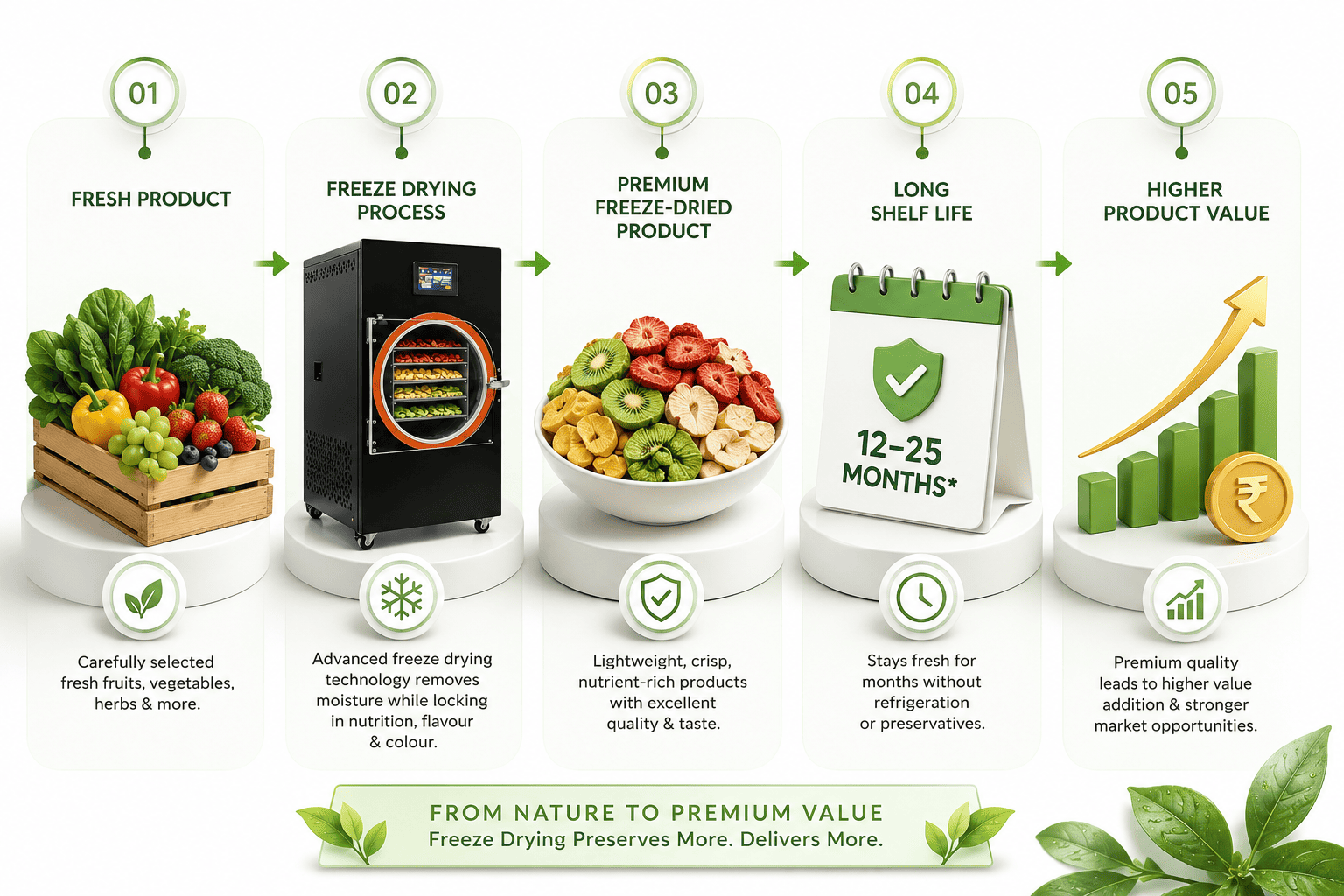
What Determines Freeze-Drying Performance?
Batch time and operating cost cannot be represented by one fixed figure. They depend on the product, moisture load, machine model, preparation method and selected process recipe.
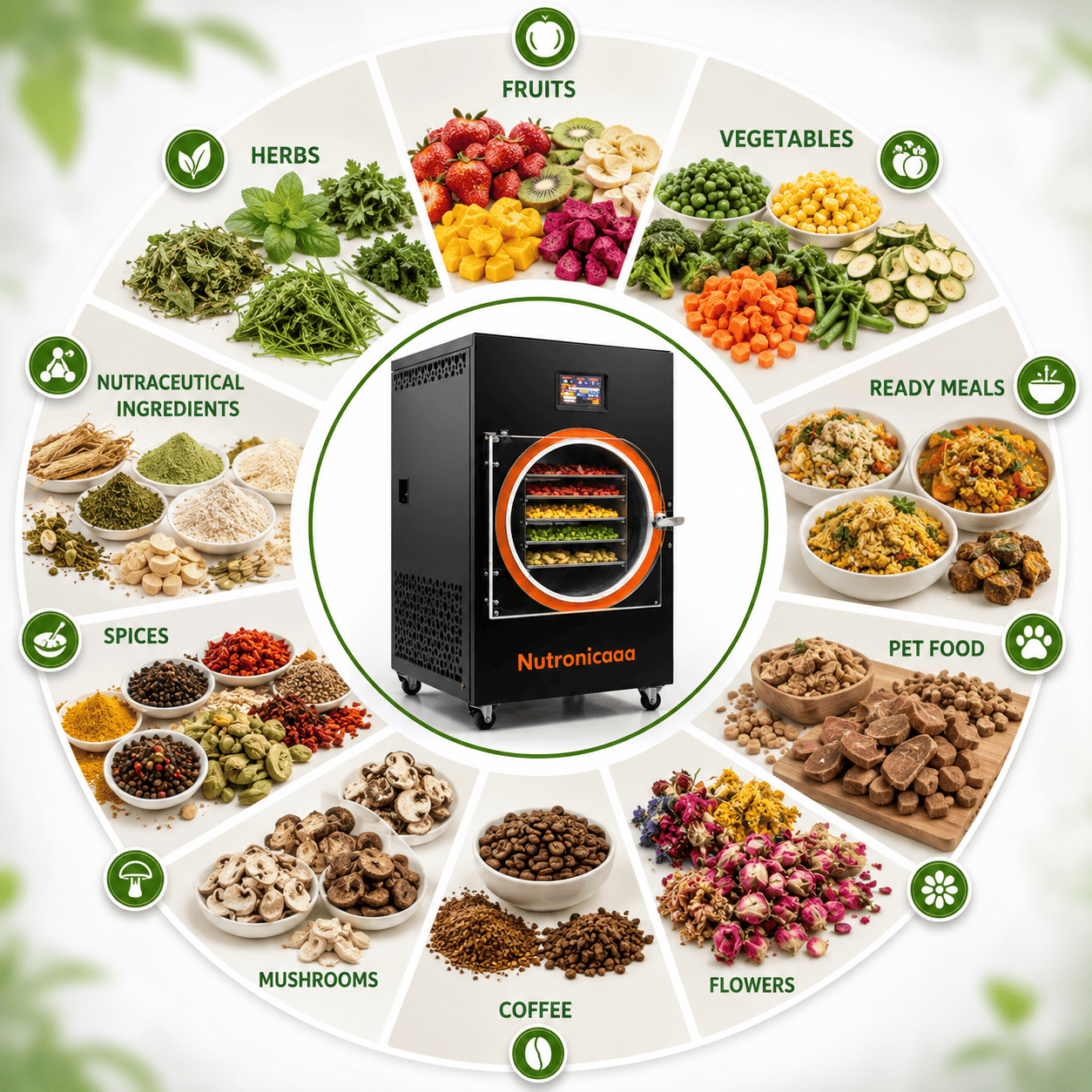
What Can Be Processed in a Commercial Freeze Dryer?
Commercial freeze-drying technology can support a broad range of food, ingredient and specialty applications.
Food Products
Fruits, vegetables, herbs, spices, mushrooms, ready meals, meat, seafood and pet treats.
Speciality Applications
Flowers, coffee, nutraceutical ingredients, herbal powders and product-development samples.
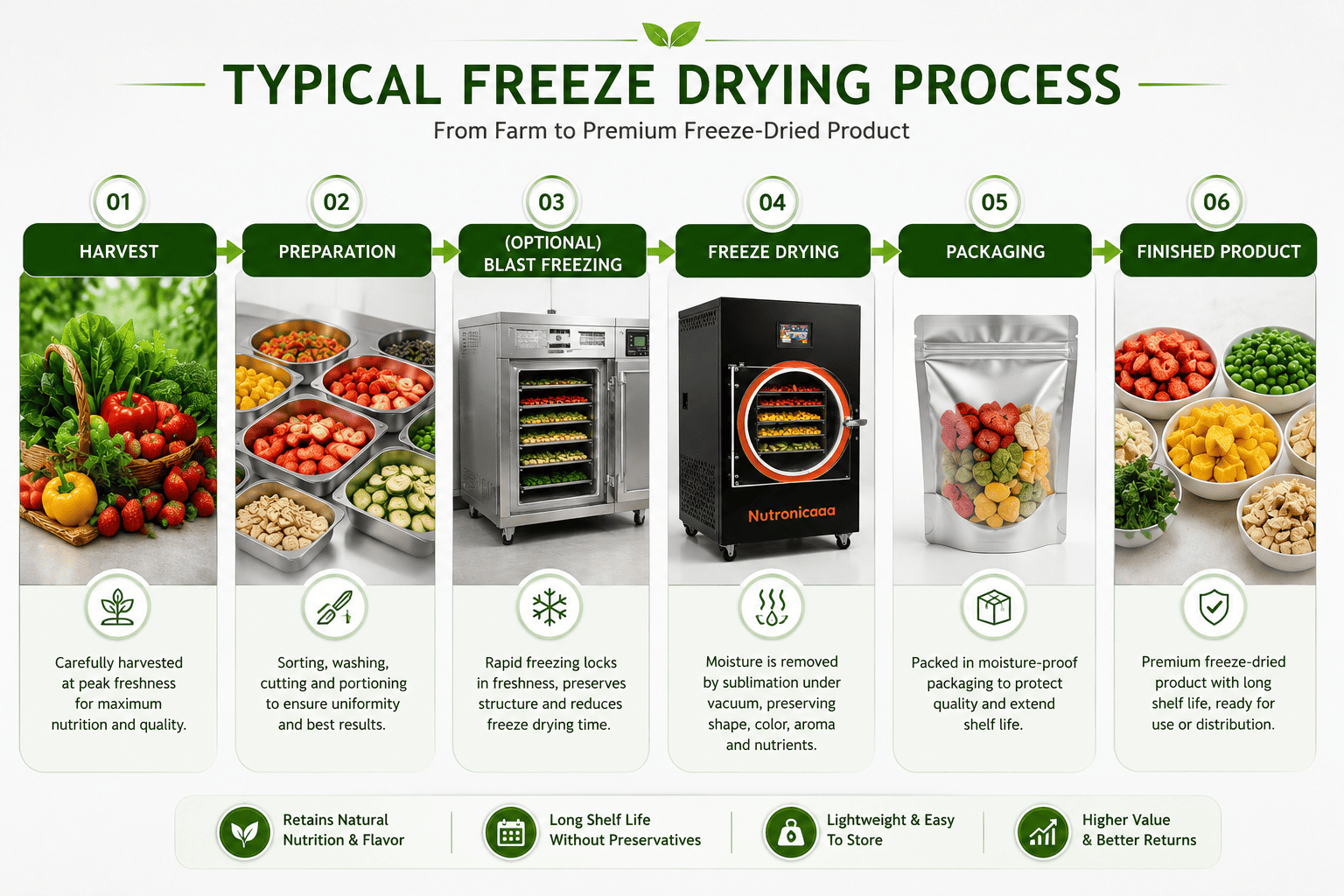
Typical Commercial Freeze-Drying Process
Product preparation and freezing quality strongly influence the final outcome. A controlled workflow improves process consistency.
Typical Freeze-Drying Cycle Duration
The following ranges are general planning references and not guaranteed cycle times. Actual results must be validated through product trials and recipe optimization.
| Product Category | Indicative Cycle Range | Important Variables |
|---|---|---|
| Light herbs and leafy products | Approximately 16–24 hours | Leaf density, loading depth and pre-freezing |
| Vegetables | Approximately 20–30 hours | Cut size, blanching and moisture content |
| Fruits | Approximately 24–36 hours | Sugar content, thickness and ripeness |
| Ready meals | Approximately 22–34 hours | Recipe, oil content and serving depth |
| Meat and pet-food products | Approximately 24–36 hours | Fat content, piece size and initial freezing |
*The cycle begins only after suitable product preparation and may include freezing time when products are not pre-frozen separately.
How Much Electricity Does a Freeze Dryer Consume?
Electricity consumption depends on machine capacity, refrigeration load, vacuum-pump size, heater operation, ambient temperature, product moisture and cycle duration.
- Compressor and condenser operation
- Vacuum-pump operating time
- Shelf heating during drying
- Product load and initial temperature
- Ambient room conditions
- Pre-freezing method
Why We Avoid One Fixed Consumption Figure
A light herb batch and a high-moisture fruit batch will not consume the same amount of electricity. Nutronicaa can provide model-specific connected load and indicative consumption guidance after understanding your product and batch requirement.
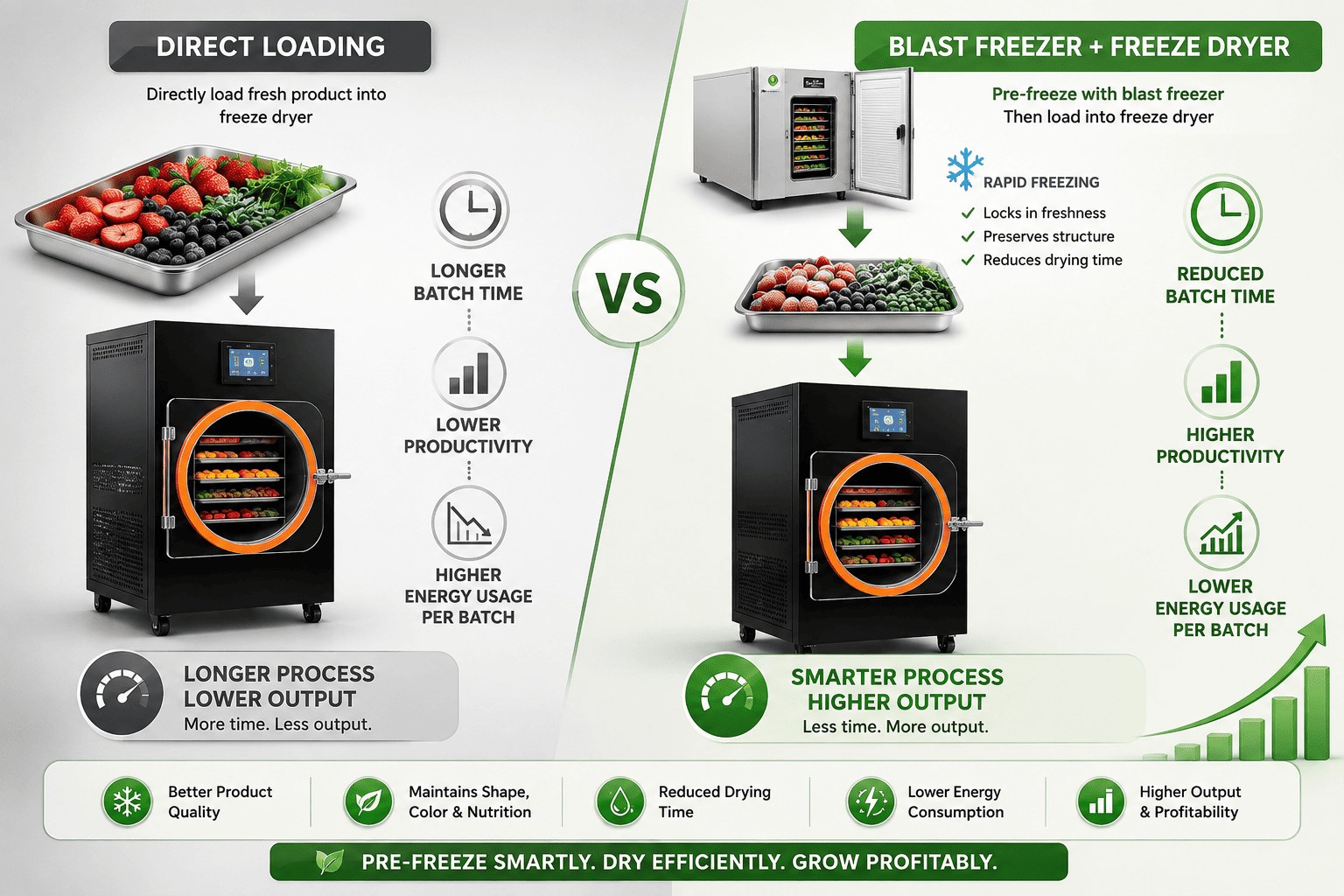
Pre-Freezing in a Blast Freezer Can Reduce Batch Time
In commercial production, products may be pre-frozen in a separate blast freezer before being transferred to the freeze dryer.
- Reduces the freezing work performed inside the freeze dryer.
- Can shorten the total machine-occupancy time per batch.
- Improves freeze-dryer utilization for drying operations.
- Supports more organized continuous-production planning.
- Provides more consistent initial product temperature.
The actual reduction depends on product type, freezing temperature, batch loading and selected drying recipe.
Understanding Fresh-to-Freeze-Dried Yield
Freeze drying removes most of the water from a product. Therefore, the finished weight is substantially lower than the fresh weight. Yield varies with moisture, solids, sugar, oil and fibre content.
| Product | Illustrative Finished Yield | Primary Influence |
|---|---|---|
| Leafy herbs | Approximately 8–18% of fresh weight | Leaf moisture and stem content |
| High-moisture fruits | Approximately 8–20% | Water and sugar content |
| Vegetables | Approximately 12–30% | Variety and solids content |
| Ready meals | Approximately 20–40% | Recipe, oil and dry ingredients |
| Meat products | Approximately 25–40% | Fat, protein and initial moisture |
*These are broad illustrative ranges. Actual yield should be measured through a product-specific trial.
What Makes Up the Operating Cost?
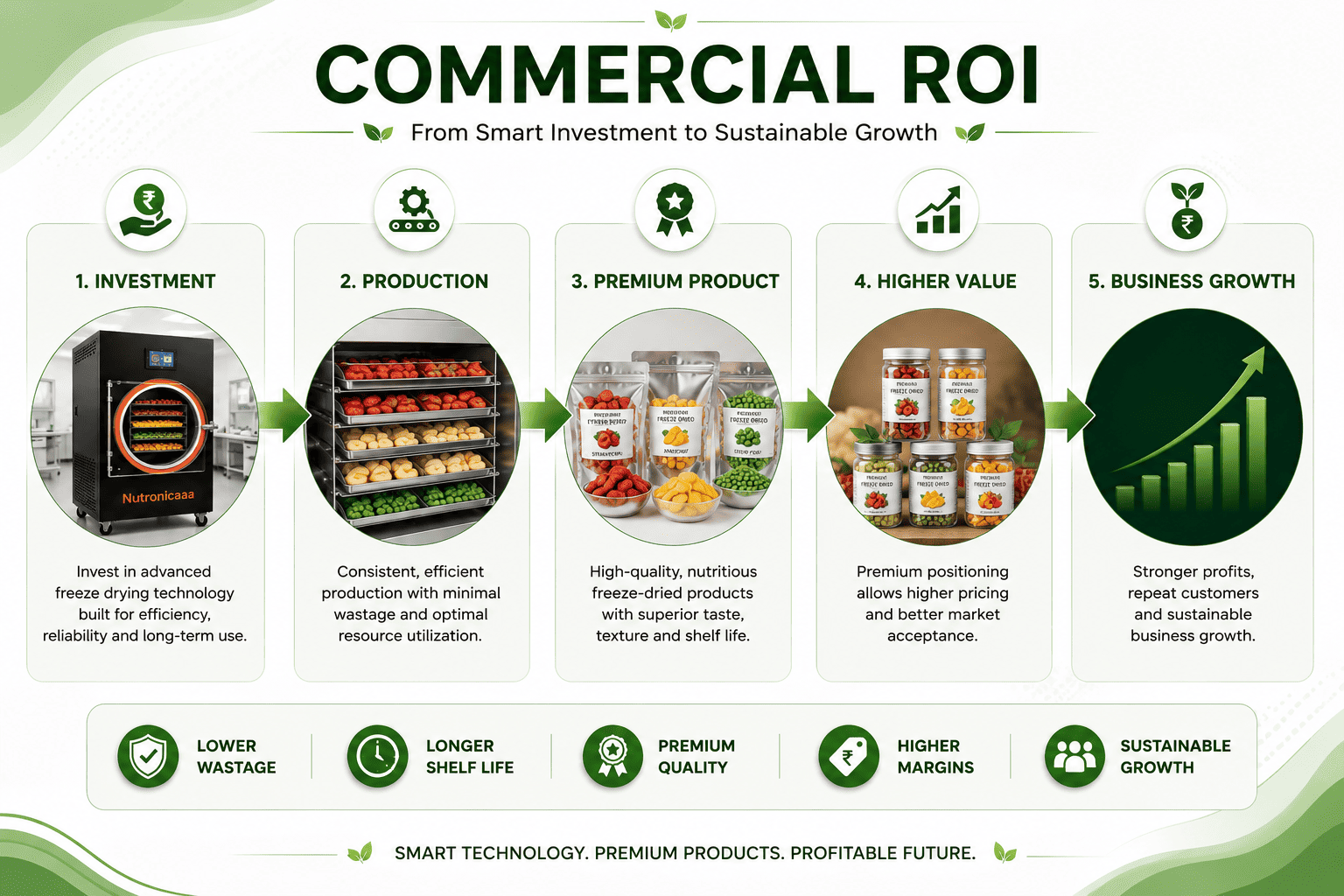
ROI Depends on Your Product and Business Model
It is not responsible to publish one fixed ROI period for every freeze-drying business. Commercial viability depends on actual costs, utilization and selling channels.
- Raw-material purchase cost
- Fresh-to-dried yield
- Batch size and machine utilization
- Packaging and marketing cost
- Wholesale or retail selling price
- Rejected batches and unsold inventory
Vacuum Pump Oil and Routine Maintenance
Vacuum-pump oil condition directly affects vacuum performance. Oil-change frequency depends on pump type, operating hours, product moisture, contamination and operating practices.
Inspect Regularly
Observe oil level, colour, clarity, smell and vacuum performance.
Use Recommended Oil
Always use the correct vacuum-pump oil grade recommended for the pump.
Change When Required
Replace contaminated or degraded oil rather than relying only on a fixed calendar interval.
Consumable Information
Model-specific oil capacity, recommended oil grade and service instructions are provided with the machine documentation and operating guidance.
Simple Maintenance Protects Performance
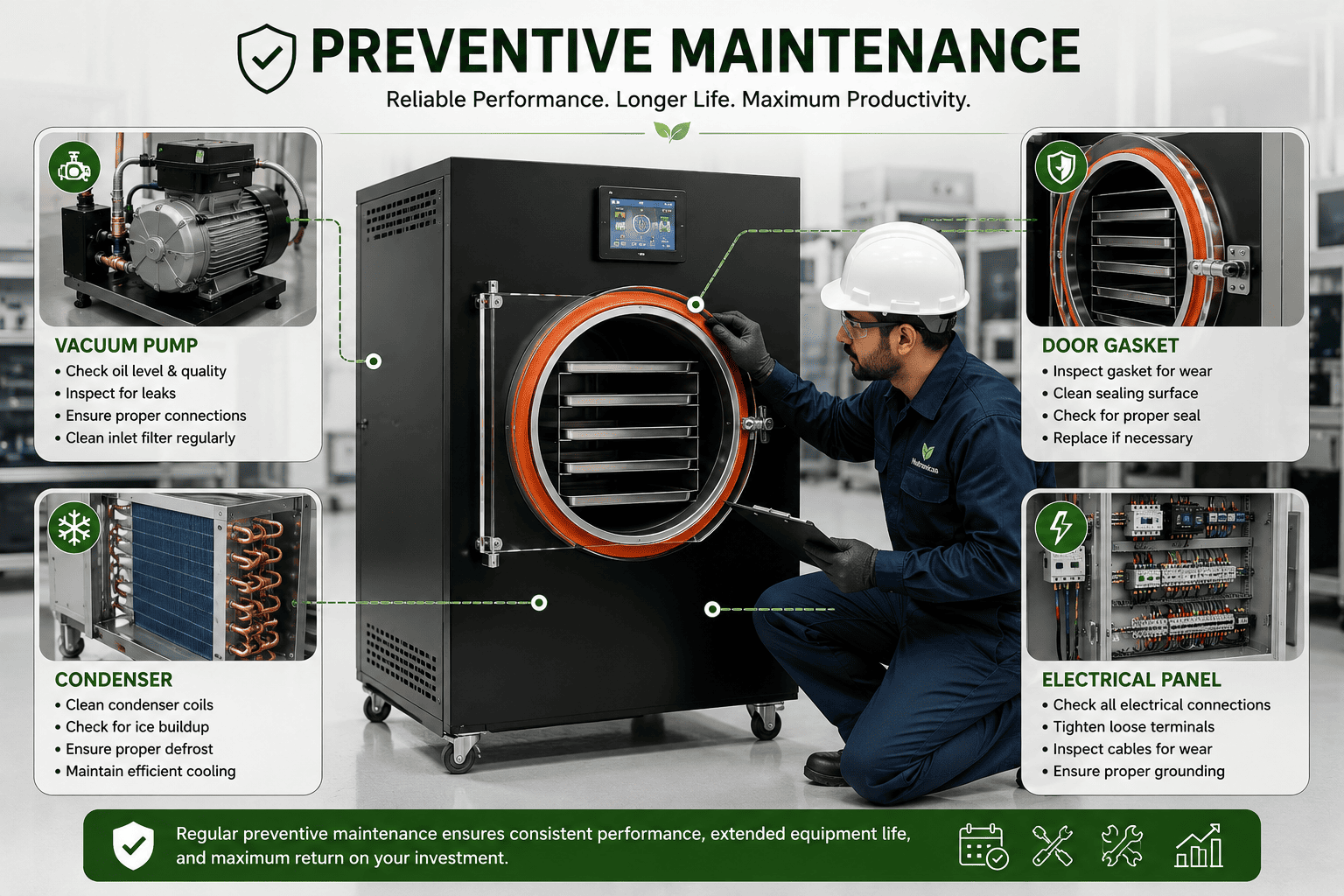
Routine inspection helps identify issues before they affect production, vacuum performance or refrigeration efficiency.
- Keep the chamber, trays and drain clean.
- Inspect the door gasket and sealing surface.
- Monitor vacuum-pump oil condition.
- Keep condenser airflow paths clean.
- Check electrical connections periodically.
- Follow recommended operating and shutdown procedures.
- Clean chamber and trays
- Check door gasket
- Inspect drain
- Check pump oil
- Inspect hoses
- Clean accessible surfaces
- Inspect electrical connections
- Check heaters and sensors
- Review vacuum performance
- Vacuum-pump service
- Refrigeration inspection
- Safety and control checks
Designed for Dependable Commercial Operation
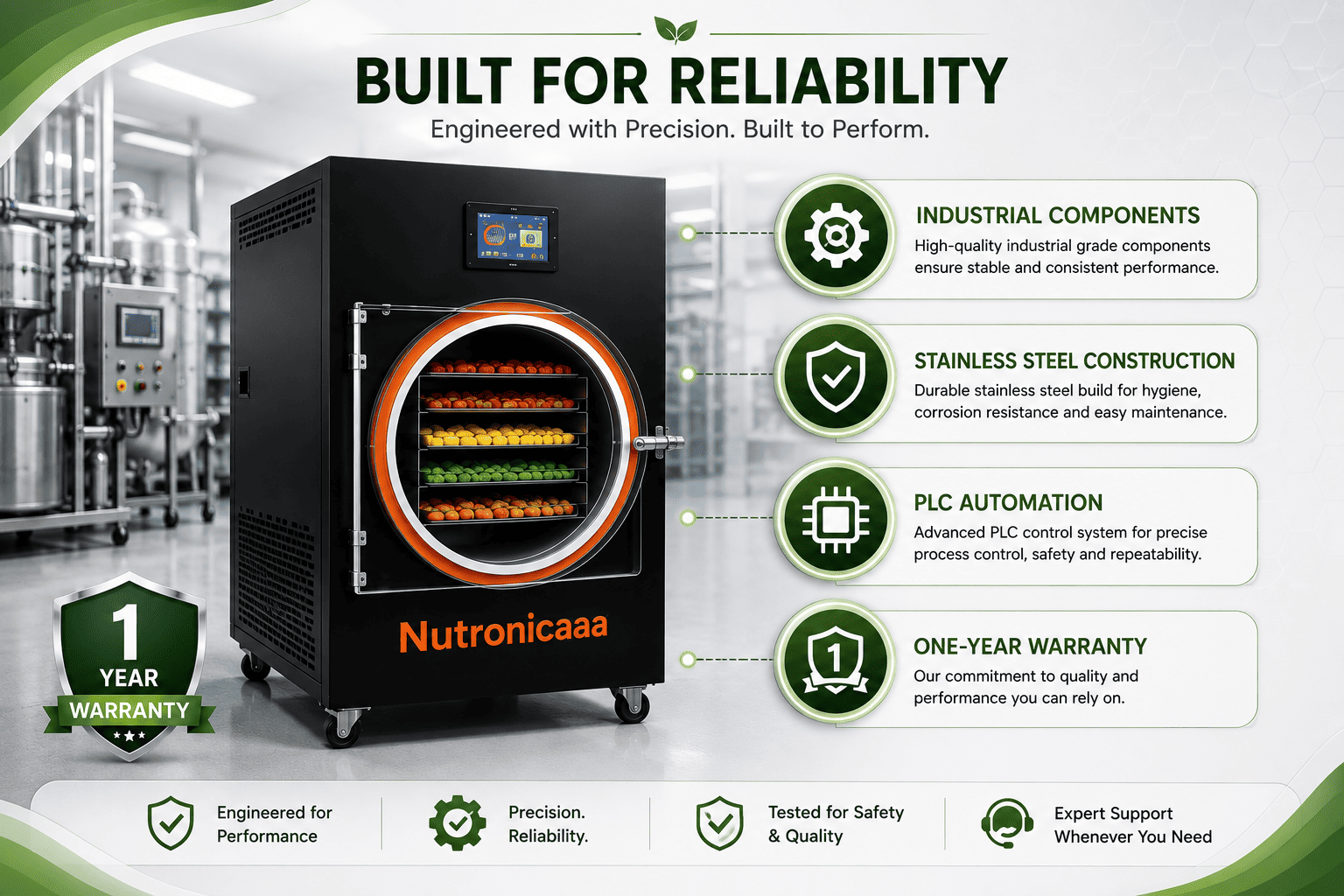
Nutronicaa commercial freeze dryers are supplied with a one-year warranty against manufacturing defects, subject to the applicable warranty terms, installation requirements and recommended operating conditions.
Machines are designed using industrial refrigeration, vacuum, stainless-steel and control components. Their actual service life depends on operating hours, product loading, maintenance, environmental conditions, electrical quality and handling.
With correct use and preventive maintenance, the equipment is designed to provide many years of dependable commercial service.
Spare Parts and Consumables
Common consumables and service components can be supplied according to the machine model and technical requirement.
Vacuum-Pump Oil
Recommended grade based on the supplied pump.
Door Seals
Door gaskets and sealing components where required.
Control Components
Sensors, contactors, relays, SSRs and electrical parts.
Refrigeration Parts
Model-specific valves, controls and related components.
A relevant spare-parts and consumables list can be provided with the quotation, machine documentation or service recommendation. Prices are confirmed according to the applicable model and current availability.
Support for Customers Across India
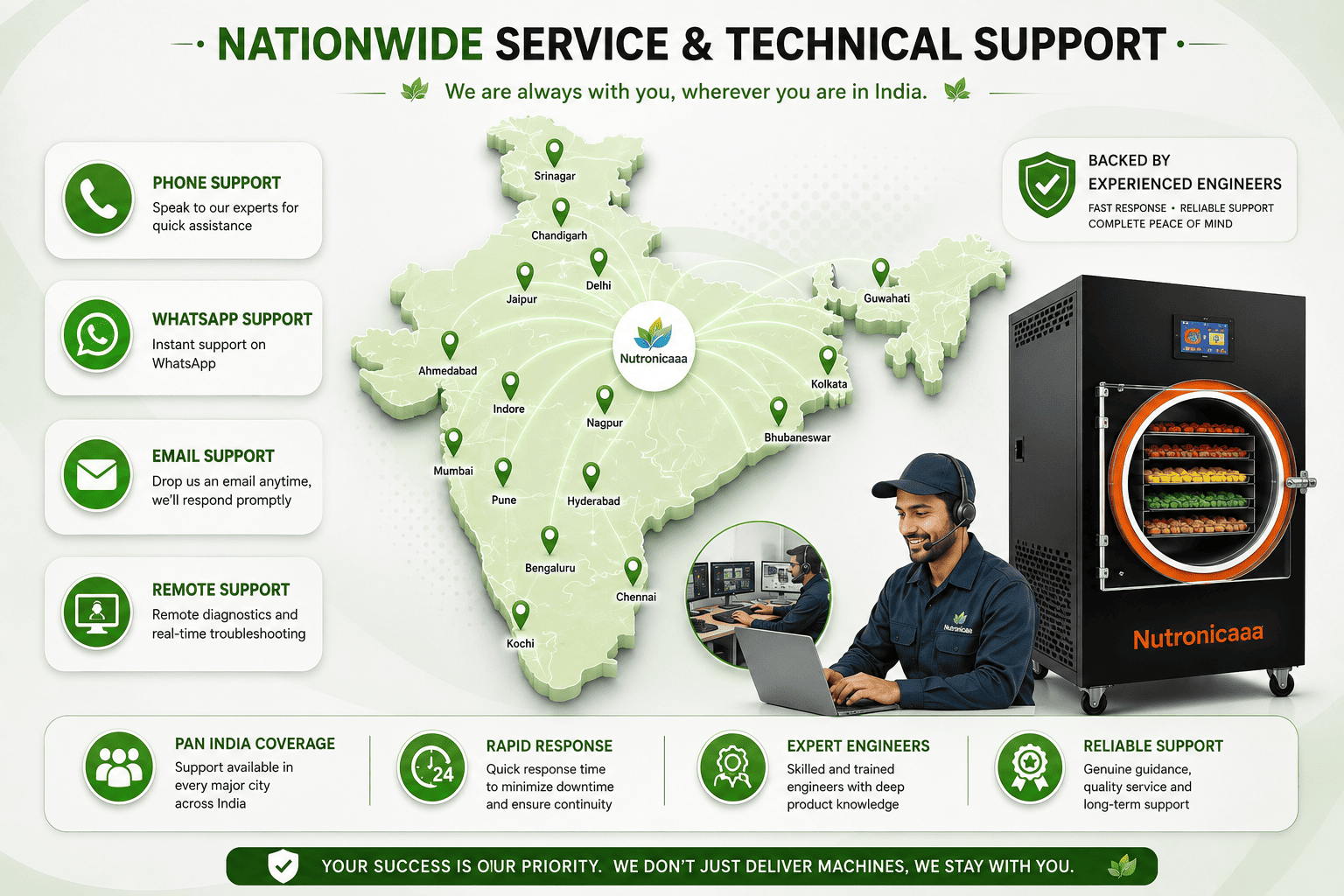
Routine refrigeration and electrical work may generally be handled by experienced commercial technicians available in major cities.
For machine-specific guidance—including PLC operation, freeze-drying recipes, vacuum sequencing, diagnostics and spare-part identification—Nutronicaa provides direct remote technical assistance.
On-site technical support may be arranged when required, subject to location, scheduling, service scope and applicable charges.
Freeze-Dried Product Samples Available on Request
Selected freeze-dried product samples may be provided for evaluation, subject to availability.
Evaluate Quality
Observe product appearance, structure, texture, aroma and overall processing quality.
Understand Applications
Explore examples from herbs, fruits, vegetables, ready meals or other available categories.
Discuss Your Product
Speak with our team regarding product suitability, trial requirements and process expectations.
Representative product images are for application reference. Actual sample categories, quantities and availability may vary. Sample pricing is not published online and is communicated according to the specific request.
Frequently Asked Questions
How many batches can a freeze dryer complete per day?
Does pre-freezing reduce freeze-drying time?
Can you provide exact electricity consumption?
What is the warranty period?
How long will the machine last?
Are spare parts available?
Can a local technician service the machine?
Do you provide product recipes?
Can every food product be freeze dried?
Can Nutronicaa calculate my ROI?
Are freeze-dried product samples available?
How do I select the right freeze dryer?
Discuss Your Freeze-Drying Project with Our Engineering Team
Share your product, expected batch size and production goals. We will help you understand the suitable machine configuration and practical processing approach.